Key takeaways
- An esthetic treatment does not treat inflammatory acne: it complements medical care; it does not replace it.
- Our acne-prone skin protocol has 3 steps: cleanse, treat, hydrate.
- The daily routine matters as much as in-clinic treatments: gentle cleansing, non-comedogenic hydration and sun protection.
- Some active ingredients should be paused around sessions, depending on what your skin tolerates.
- Painful nodules, pitted scars: these signs call for a physician, not an esthetician.
Can acne be treated at an esthetics clinic?
We need to be clear about how the roles are divided. Inflammatory acne, the kind that produces deep, painful breakouts and leaves scars, is a matter for a physician or a dermatologist. An esthetic treatment has neither the mandate nor the means to treat it.
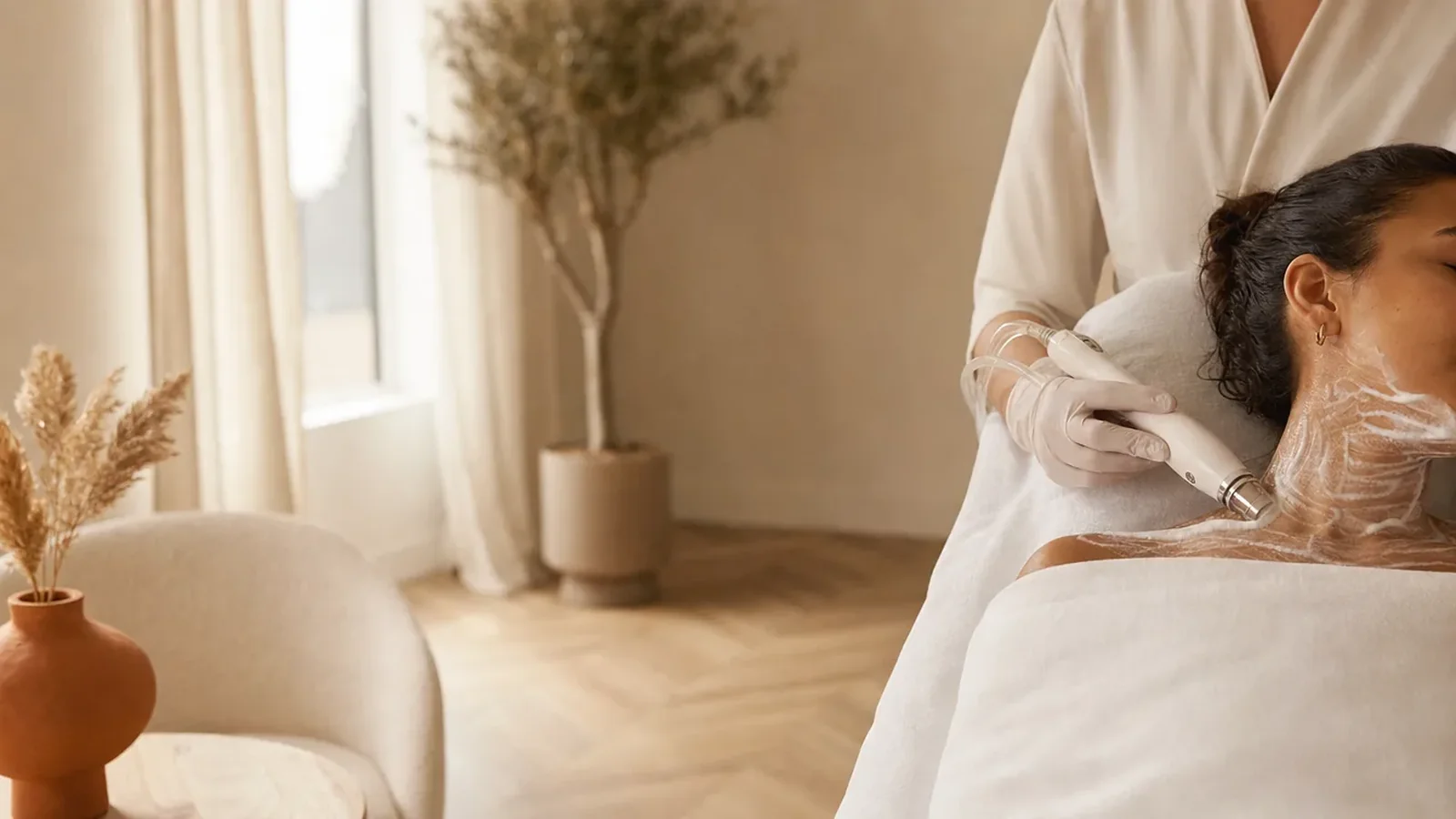
What an esthetics clinic can do, on the other hand, is real: reduce congestion, calm a reactive skin, improve texture, soften the marks left by past breakouts, and support skin that has become dry or sensitized by medical treatment. That is exactly where we come in, as a complement and never as a substitute.
How does the 3-step protocol work?
- Cleanse. We cleanse thoroughly and clear congested pores without drying the skin out, because irritated acne-prone skin produces more sebum and becomes inflamed more easily.
- Treat. Depending on the state of the skin, we work the surface with a suitable treatment: targeted cleansing, gentle exfoliation or, when it is indicated, a chemical peel to even out tone and marks. For marks that are already established, microneedling becomes the option to consider.
- Hydrate. This is the step acne-prone skin skips most often, wrongly. Dehydrated skin defends itself by producing more sebum. So we finish with non-comedogenic hydration suited to your skin type.
Every session is adjusted to what your skin presents that day. A fixed protocol, applied the same way at every visit, is not effective.
What daily routine should you follow with acne-prone skin?
- Gentle cleansing, morning and evening. A non-aggressive cleanser is enough. "Stripping" gels that leave the skin tight do more harm than good.
- Non-comedogenic hydration. A light cream, chosen so that it does not clog pores.
- Sunscreen every morning. Non-negotiable, even in winter, even under clouds.
- Complete makeup removal in the evening. Makeup left on overnight is a classic cause of congestion.
- Hands away from the face. Do not pop, do not pick: every pimple that is manipulated risks leaving a mark that lasts longer than the pimple itself.
Which ingredients should you avoid?
What irritates varies from one skin to another, but some habits cause problems on acne-prone skin:
- Too many active ingredients at once. Layering an acid, a retinoid and an anti-blemish treatment on the same evening damages the skin barrier.
- Aggressive mechanical exfoliation (grain scrubs, harsh brushes), which irritates and encourages marks.
- Heavily fragranced products, or products with alcohol at the top of the list, often poorly tolerated.
- Occlusive oils and butters on skin that already tends to congestion.
Around an in-clinic treatment, we tell you precisely what to pause and for how long. Do not restart your active ingredients on your own: ask us.
Why is sun protection non-negotiable?
Because the marks left by acne darken in the sun. They are post-inflammatory spots: the more UV the skin receives, the more durably the pigment settles in. You can spend months evening out a skin tone and lose it all in a single day of exposure.
In practice: a sunscreen suited to your skin every morning, reapplied if you are outdoors, and shade during peak hours. It is the measure with the best return in the whole routine.
Does diet really affect the skin?
Diet is neither the sole cause of acne nor a miracle solution. What we observe fairly consistently: fast sugars and highly processed products are associated with more breakouts in some people. If you notice a link in your own case, it is worth adjusting.
But beware of radical diets found online. Skin needs to be nourished, not punished. If in doubt, talk to a health professional rather than a forum.
When should you see a doctor or a dermatologist?
Consult without delay if you have: deep and painful nodules, acne that leaves pitted scars, a sudden and widespread breakout, or acne that has not responded to anything for months. These situations require medical treatment, and the delay is paid for in scars.
If you are already following a medical treatment, our role is to complement it: hydrate skin dried out by the treatment, soothe irritation, and work on texture and marks once the breakout is under control. We never modify a prescribed treatment: that stays between you and your doctor. To place what falls under esthetic care, our article on blemish-prone skin and when to consult goes into detail.
How often should you return for treatments?
Acne-prone skin is followed over time, not in a single session. We set the rhythm of visits together after assessing your skin, then adjust it according to results. Consistency matters more than intensity: sessions close together do not replace a sustained rhythm.
Not sure whether your skin calls for esthetic care or a doctor? Book a consultation at Institut V Esthétique, at 6532 Beaubien East, Montreal, or call us at (438) 900-0919. We look at your skin and tell you honestly what is within our scope and what is not.
Frequently asked questions
Can esthetic care alone resolve my acne?
No, not if the acne is inflammatory. An esthetic treatment improves congestion, texture and marks, but it does not replace medical treatment. If that is what you need, we will refer you.
Why should you not pop your pimples?
Because the mark left by a manipulated pimple often lasts longer than the pimple itself. Popping adds inflammation and a wound, and on skin that already produces pigment, that inflammation often turns into a brown spot.
How many sessions will it take?
It depends on your starting condition and on how consistent you are with the routine at home. We discuss it after the first assessment, with a realistic goal rather than a sales number.
Is a peel suitable for skin with breakouts?
It depends on the state of the skin that day: on an active, inflammatory breakout, we do not perform a peel. Once the breakout has calmed, a peel can help even out tone and marks.
Do I have to stop wearing makeup?
No, but choose non-comedogenic formulas and remove makeup completely every evening. It is at night that makeup left in place does the most damage.
In short
Acne-prone skin is addressed on two fronts: the medical one, when it is necessary, and daily care, which decides texture and marks. At Institut V Esthétique, in Beaubien, we work in 3 steps (cleanse, treat, hydrate) and we tell you frankly when your situation calls for a doctor. Book your free consultation at Institut V Esthétique to see clearly.