Key takeaways
- Blemish-prone or congested skin is not automatically diagnosed acne.
- Institut V may provide esthetic cleansing, gentle exfoliation, superficial extraction and hydration; it does not diagnose or treat a skin disease.
- HydraFacial may support the appearance of congested pores and blackheads, but it does not “cure” acne.
- Microneedling is intended for selected older scars and must be postponed when active inflammatory acne is present.
- Peels are not suitable for every irritated or inflamed skin condition; The Perfect Derma Peel requires the medical oversight specified by its manufacturer.
- Nodules, painful cysts, progressive scarring, widespread inflammation or acne that does not improve with routine care require a physician or dermatologist.
Esthetic care, medical acne treatment and referral to a physician
The essential distinction is this: an esthetic facial may improve the appearance of congested skin, but only a healthcare professional can diagnose acne and establish medical treatment. Institut V Esthétique is an esthetics salon, not a medical clinic.
| Observed situation | Possible role for Institut V | When to see a physician |
|---|---|---|
| Blackheads, congested pores and uneven texture without significant pain | HydraFacial or a personalized facial to cleanse, gently exfoliate, extract at the surface and hydrate. | If congestion becomes very inflamed, persistent or scarring. |
| A few occasional superficial blemishes | Adapt the facial and esthetic routine without making a diagnosis. | If lesions multiply, become painful or resist routine care. |
| Numerous inflamed papules or pustules | Postpone aggressive extraction, microneedling and irritating protocols. | Assessment by a physician or dermatologist to diagnose and treat acne. |
| Deep nodules, cysts, pain or progressive scarring | No medical treatment; protect the skin and avoid manipulating lesions. | Prompt medical consultation is recommended to limit scarring. |
| Dark marks after healed blemishes | Assess gentle radiance-focused care once inflammation has resolved. | If pigmentation is new, changing, widespread or associated with a skin condition. |
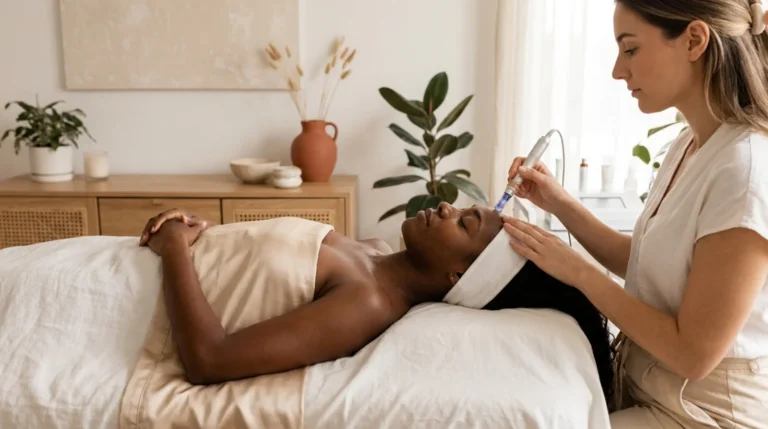
| Older atrophic scars without active acne | ePen microneedling may be discussed after contraindications are reviewed. | For deep scars, keloids or uncertain diagnosis. |
What can an esthetic facial do for blemish-prone skin?
Esthetic care can remove superficial debris, gently exfoliate, perform cautious extractions, hydrate and support the skin’s overall appearance. Institut V presents HydraFacial as a treatment combining cleansing, exfoliation, extraction and hydration. For mild congestion without significant inflammation, it may help the skin look clearer; it does not replace medical acne treatment.
Where does Institut V’s role end?
An esthetician may observe surface condition, adapt a cosmetic facial and recognize when a concern falls outside the esthetic scope. An esthetician must not diagnose hormonal, cystic or infectious acne, prescribe medication, change a prescription or promise to cure acne. Diagnosis, medication and medical monitoring belong to a physician or dermatologist.
Is HydraFacial suitable for everyone with breakouts?
No. It may be considered for congested pores, blackheads and selected superficial blemishes. Very red, painful, open or infected lesions require a different approach and often medical advice. Aggressive extraction on inflamed skin can increase irritation.
When may microneedling be considered?
Microneedling must not be presented as care for active acne. It may be discussed for the appearance of selected older atrophic scars after inflammatory breakouts are controlled. Active acne, infection, an open wound, keloid tendency, current or recent isotretinoin use and every other contraindication must be disclosed before an appointment.
What about chemical peels?
Chemical exfoliation may irritate skin that is already inflamed, broken or recently exposed to strong active products. The Perfect Derma Peel is listed by Institut V for selected pigment and scar concerns, but its manufacturer requires a medical environment and medical professional. Until that oversight is documented, it must not be presented as a simple anti-acne facial administered by an esthetician.
Which signs require a physician or dermatologist?
Seek medical care for deep nodules or cysts, significant pain, widespread lesions, developing scars, substantial hyperpigmentation, sudden severe onset, acne that does not respond to routine care or a substantial impact on well-being. An uncertain diagnosis also requires medical advice: rosacea, folliculitis and perioral dermatitis can resemble acne. Rapidly spreading redness, significant swelling, fever, crusting, drainage or other signs of infection require prompt medical assessment.
How should you prepare for an esthetic consultation?
Bring a list of medications, active products and recent treatments. Disclose prescription retinoids, isotretinoin, antibiotics, pregnancy or breastfeeding, a history of cold sores and skin reactions. The esthetic consultation determines whether gentle care is reasonable or whether medical advice should come first.
Medical sources consulted: American Academy of Dermatology, acne treatment; Canadian Dermatology Association, acne; American Academy of Dermatology, chemical peels; Cleveland Clinic, microneedling.
For blackheads or mild congestion without significant pain, an esthetic consultation may help select gentle care. For deep, painful, widespread or scarring acne, see a physician or dermatologist first.
For an esthetic consultation, call (438) 900-0919 or contact Institut V.
Frequently asked questions about esthetic care and acne
Can HydraFacial cure acne?
No. HydraFacial may support the appearance of congested skin through cleansing, gentle exfoliation, superficial extraction and hydration, but it does not diagnose or cure acne.
Can microneedling be performed on active acne?
Microneedling should be postponed on an area with active inflammatory acne, infection or open wounds. It may sometimes be discussed later for selected older scars after assessment.
When should you see a dermatologist for acne?
Seek medical care for painful nodules or cysts, widespread lesions, progressive scarring, sudden severe onset or acne that does not respond to routine care.